Monday, October 31, 2016

Marvelous Middle Grade Monday: JOURNEY'S END by Rachel Hawkins

Blog Tour for JOURNEY'S END by Rachel Hawkins (October 25th, 2016)

What It's About: 
The town of Journey's End may not literally be at the end of the world, but it sure feels like it to Nolie Stanhope. Spending the summer with her scientist father in the tiny Scottish village isn't exactly Nolie's idea of a good time, but she soon finds a friend: native Journey's Ender Bel McKissick.

While Nolie's father came to Journey's End to study the Boundary--a mysterious fog bank offshore--Bel's family can’t afford to consider it a threat. The McKissick’s livelihood depends on the tourists drawn by legends of a curse. Still, whether you believe in magic or science, going into the Boundary means you'll never come back.

…Unless you do. Albert Etheridge, a boy who disappeared into the Boundary in 1914, suddenly returns--without having aged a day and with no memory of the past hundred years. Then the Boundary starts creeping closer to the town, threatening to consume everyone within.


While Nolie's father wants to have the village evacuated, Bel's parents lead the charge to stay in Journey's End. Meanwhile, Albert and the girls look for ways to stop the encroaching boundary, coming across an ancient Scottish spell that requires magic, a quest, and a sacrifice.

First Lines:
"Albert Macleish woke up early on the morning he disappeared.

It had to be early is he was to leave without his mum and da noticing, so it was still murky and dim when he opened the front gate and slipped out into the quiet, rutted lane that ran past his house..."

Impressions:
I'm just in love with this cover! Spooky Scotland seems to be all the rage this year, Earlier this year, I reviewed Janet Fox's THE CHARMED CHILDREN OF ROOKSKILL CASTLE, and if you liked that I believe you will like Rachel Hawkin's JOURNEY'S END also. The friendships are strong, the fog is scary, and who doesn't feel the hairs on the back of their necks prickle when you hear the words "ancient Scottish spell that requires magic, a quest, and a sacrifice"?

About The Author:
Rachel Hawkins is the author of the Hex Hall series. She lives in Alabama.

Rachel Hawkins' Tumblr photo
Other stops on the Blog Tour:
10/24: The Reading Nook 
10/25: Buttermybooks 
10/27: Novel Novice 
10/28: In Wonderland 
11/2: YA Bibliophile 
11/4: The Book Wars 

Monday, October 24, 2016

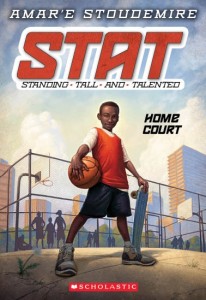
Marvelous Middle Grade Monday: The STAT series by Amar'e Stoudamire

My youngest son is a basketball fiend, and last year (when he was in 3rd grade) he found this series in his school library. We've spent many an evening reading through the series. If you have a sports-loving kid, be sure to check these out!

What They're About
Based on NBA-star Amar'e Stoudamire's life, these books trace the success of young Amar'e (a.k.a STAT, the name given him by his father, and which is an abbreviation of "Standing Tall and Talented") on his middle school basketball team. STAT has two close friends, Deuce and Mike, who also love to play basketball--but Amar'e's talent takes him to another level, causing a rift. However, by the third book, the friends realize Amar'e's talent really is something else, and become his biggest supporters as he joins the school team and has to deal with some hostile 8th-graders.

There are five books in the series now. The first on e was published by Scholastic in 2012. Amar'e Stoudamire actually writes very well, and the books are well-structured and enjoyable. Other subjects dealt with include divorce (Amar'e's parents live in separate states,) and balancing school work with sport.

About the Author:
Born and raised in Lake Wales, Florida, Amar'e Stoudamire was a stand-out high school player, who went straight from high school to the NBA when he was drafted by the Phoenix Suns in 2002. During his career, he played for the New York Knicks, the Dallas Mavericks, and the Miami Heat. He currently plays for Hapoel Jerusalem.


Wednesday, October 12, 2016

ADDISON COOKE AND THE TREASURE OF THE INCAS by Jonathan W. Stokes

ADDISON COOKE AND THE TREASURE OF THE INCAS by Jonathan W. Stokes (Philomel, October 11th, 2016)

This is hot off the presses--and I'm part of a select blogging group who are featuring it this week. Other participants are:

Monday, 10/10 | Novel Novice
Tuesday, 10/11 | Ms. Yingling Reads
Wednesday, 10/12 | Middle Grade Mafioso
Thursday, 10/13 | The Reading Nook
Friday, 10/14 Stories & Sweeties

What It's About (via Goodreads):
Smooth-talking, refined twelve-year-old Addison Cooke loves a grand adventure, especially one that involves using his vast knowledge of history and archaeology, learned from his aunt and uncle, both world-famous researchers. If that adventure includes an expertly-knotted Windsor tie and an Arnold Palmer on the rocks, all the better.

Luckily for Addison, adventure has a way of finding the Cookes. After Addison's uncle unearths the first ancient Incan clue needed to find a vast trove of lost treasure, he is kidnapped by members of a shadowy organization intent on stealing the riches. An expert in Incan history, Addison's uncle is the bandits' key to deciphering the ancient clues and looting the treasure. . . unless Addison and his friends can outsmart the kidnappers and decipher the clues first. So it's off to Peru (business class, no less), across the Amazon, and all the way to Machu Picchu in a race for riches and history.

First Lines:
Addison Cooke sat cross-legged in the school library, engrossed in an Incan history book. Under the spell of a decent read, Addison could forget meals, forget sleep, and even forget to go to class."

Here's The Scoop:
This is a helter-skelter ride of a novel, with chase after chase. (I keep thinking, as I was reading, what a great movie it would be.) There are evil archaeologists complete with a gang of Russian henchmen; Ecuadorian gangsters; and caimans--South American alligators--just dying to take a bite out of you. There are spills and scrapes aplenty, and the '86-ers' (named after the street they live on in New York City) are up to the challenge. Jonathan Stokes does a great job of bringing his kid characters to life, giving each of them recognizable quirks. Addison comes across as a bit of an English gentleman from bygone days, and is quick on his feet. Molly, his sister, is a speedy sportswoman. Eddie is a bit nervous, but is invaluable for his Spanish skills, and Raj is a highly decorated Boy Scout and survival camp veteran with a brown belt in karate.

The plot hinges on deciphering the three keys that will lead to the hidden Incan treasure (which is based on a legend.) I enjoyed the setting and getting to learn some details of Incan history at the time of the conquistadores. This is a fun, fun read that really hits the middle grade adventure sweet-spot. (Oh, and the cover's tremendous too!)

About The Author:
Jonathan Stokes is a screenwriter living in Los Angeles. He has written on assignment for Fox, Paramount, Universal, Warner Brothers, New Line, and Sony. He is the author of several upcoming kids' books being published by Penguin Random House. Jonathan is a street taco aficionado, an urban explorer, and koala enthusiast. WEBSITE  TWITTER

Monday, October 3, 2016

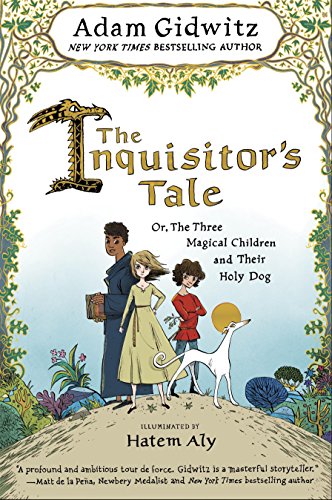
THE INQUISITOR'S TALE Or, The Three Magical Children and Their Holy Dog by Adam Gidwitz (Dutton Books for Young Readers, September 27, 2016)

What It's About:
1242. On a dark night, travelers from across France cross paths at an inn and begin to tell stories of three children. Their adventures take them on a chase through France: they are taken captive by knights, sit alongside a king, and save the land from a farting dragon. On the run to escape prejudice and persecution and save precious and holy texts from being burned, their quest drives them forward to a final showdown at Mont Saint-Michel, where all will come to question if these children can perform the miracles of saints.


Join William, an oblate on a mission from his monastery; Jacob, a Jewish boy who has fled his burning village; and Jeanne, a peasant girl who hides her prophetic visions. They are accompanied by Jeanne's loyal greyhound, Gwenforte . . . recently brought back from the dead. In a style reminiscent of The Canterbury Tales, our narrator collects their stories and the saga of these three unlikely allies begins to come together.

Why I Loved It:
This is clever, fun, philosophical and highly entertaining. Adam Gidwitz (who wrote the highly popular Grimm trilogy) is steeped in medieval French lore, and there are surprises aplenty. The supernatural is not considered outlandish--there are indeed canine resurrections, farting dragons, a character who can foresee the future through visions akin to epilepsy, and an archangel. I loved all three of the children, a motley crew who band together to come to the rescue of each other--and whose goal is to prevent the mass burning of Talmud books in Paris. There's also a magnificent chase across the causeway to Mont-Saint-Michel. This would be a great classroom read-aloud for 5th grade and up.

I was fortunate to be able to ask Adam some questions about medieval France. He replied in the form of a fun quiz.

Six Things Fun, Fantastic, and Fabulous about [Medieval] France

How about we do this in the form of a quiz? Let’s go! (Note: if I’m going to visit your school, please don’t share this with your students. I will give them a form of this quiz in person! And it’llbe way funnier in person, I promise.)

QUESTION THE FIRST: In the Middle Ages, there were men called Inquisitors. What was their job? WAS IT...
a) to act as the detectives for the Pope and the Church
b) to find people who believed in God incorrectly and to punish them
c) to collect stories and write them down

ANSWER:  Inquisitors acted as detectives for the church, finding people who believed in God incorrectly and punishing them. Some wrote the stories of their investigations down. So, all of them.

QUESTION THE SECOND: When it got cold at night, where would peasants’ cows sleep?  WAS IT...
a) in the church 
b) in their owners’ beds 
c) underground

ANSWER When it got cold at night, the cows would often sleep in the peasants’ homes, and sometimes curled up in their beds of straw next to them! So yes, peasants slept with their cows. When it was cold and rainy during the day, they would often leave the cows in the church—because Mass was only on Sundays, and it was a nice, sturdy building. But at night, they wanted the cow’s body heat. Like the biggest, smelliest space-heater ever invented. 

QUESTION THE THIRD: The monastery of Mont-Saint-Michel had some serious natural defenses, which was good, because the monks who lived there were regularly attacked by Vikings, Normans, Bretons, and just about anyone with an army. Which of these defenses did it have?
WAS IT...
a)surrounded by cliffs 
b)able to suddenly become an island 
c)surrounded by quicksand 

ANSWER: All of the above!!! It is built on cliffs, surrounded by quicksand, and when the tide comes in, it becomes an island!  This is absolutely true. I have walked in the bay, when the tide was out, and our expert guide took us to a bed of quicksand and taught us how to sink into it—and how to get out. WARNING: if you visit Mont Saint Michel, ONLY walk in the bay if you have an expert guide who does this every day of his or her life. Otherwise you may indeed drown and die. Consider yourself warned.  

QUESTION THE FOURTH: What was illegal for Jews in France in the High Middle Ages? WAS IT...
a) joining a trade guild, like the blacksmiths’ guild, the weavers’ guild, or the architects’, and learning a craft  
b) learning howto read 
c) studying with Christians 
d) reading the Talmud, which is the Jewish companion to the Bible 

ANSWER: Most Jewish children learned to read, which was otherwise very rare in the Middle Ages. Even girls often learned to read.  Jewish rabbis often studied with Christian monks, comparing translations of the Bible and teaching each other new methods of scholarship.  Jews were severely constrained, though, in how they were allowed to earn money. They couldn’t join the guilds, almost none of them owned land, and so they were forced into either rag-picking, trading, or money-lending. And in 1242, twenty-thousand volumes of Talmud were burned in the center of Paris. 

QUESTION THE FIFTH: If you were at a lord’s banquet in the High Middle Ages and you had to pee, where would you go? WAS IT...
a) to the bathroom, obviously 
b) to the outhouse 
c) in the closest corner 

ANSWER: If the lord was really fancy, he might have had an outhouse. But probably, you just would have gone in the corner.  

QUESTION THE LAST: In the Life of Saint Martha, written in the 1280s, what was the diabolical power of the dragon that Saint Martha killed?  WAS IT...
a) the ability to transform itself into a murderous chicken 
b) irresistible tickling ability 
c) farts so deadly that when they touched you, you burst into flames 

ANSWER: It was the farts. Really. All of this, and much more, appears in The Inquisitor’s Tale. Check it out!

About the author: 
Adam Gidwitz is the author of the critically acclaimed, New York Times bestselling Grimm trilogy. He spent six years researching and writing The Inquisitor’s Tale, including a year living in Europe. Adam lives with his family in Brooklyn, NY. Find Adam online at adamgidwitz.com or @AdamGidwitz.


Tuesday, September 27, 2016

The Back-to-School Bookshelf Tour: Part Two


Last week the Don and I welcomed four fantastic middle grade writers to the blog. The good news: now there are eight! Please welcome them, and then enter to win each one of their books at the Rafflecoptor link below:

1) MGM: "What is the funniest mistake you ever made on your journey to publishing this book?"

Mike Grosso
I AM DRUMS
Released: 9/6/2016

My funniest mistake was emailing my editor when I should have been watching my son, who was two at the time. I was trying to send my first round of revisions when he ran up to my desk and pounded on the keyboard, auto-correcting several words and sending my half-finished email in the process. That technically means my editor received an email with "I AM DRUMS Revisions" in the subject line full of incomprehensible gibberish. My son thankfully didn't interfere when I sent a follow-up later that day with an explanation of what had happened.


2) Who are your favorite (middle grade) writers?

Sarah Reida
MONSTERVILLE: A Lissa Black Production
Release: Sept. 20, 2016

It depends on what kind of book I'm in the mood for. If it's humor - which is what I usually read - it's Judy Blume. Gosh, I love her Fudge series. I will never forget how ashamed I felt when I was eight and accidentally left a library book of Superfudge on the back bumper of our van. When we drove the van, the book fell off, got rained on, and was then picked up by the librarian at my grade school. (Thanks, Mrs. Clasquin!). I paid for it out of my own allowance - $8. And I still have it! Partly out of shame, and partly because I truly love that book and there's no such thing as a "ruined" book so long as you can read the words. (For the record, the only ruined books I own are the THREE John Green novels my dog has eaten. The man offends him).

3) MGM: Pick a favorite scene from your novel, and say why you like it.

Kathleen Burkinshaw
THE LAST CHERRY BLOSSOM
Released: August 2, 2016

I loved writing about the Cherry Blossom celebration because it was one of my mother’s favorite memories with her entire family and her friend.  It was also one of the last “normal” holidays before the atomic bombing on August 6th. This quote seemed to sum up my mother's thoughts: "I looked around the room at their happy faces, realizing that even though there is so much uncertainty and fear, joyful, happy moments still existed. And I smiled."


4) MGM: "What book is on your nightstand now?"

Jennie K Brown
POPPY MAYBERRY, THE MONDAY
Released: September 13

Right now I am reading What Light by Jay Asher. I love his work and was so excited to pick up a copy at ALA in late June! I'm about half way through it so far and it's absolutely magical. The setting is during the holiday season, so it gives you all the warm and fuzzy Christmas feels!


ENTER TO WIN HERE

Tuesday, September 20, 2016

The Back-To-School Bookshelf Tour: Part One


One of the great things about being The Don's slave employee is meeting so many middle grade--I mean "top-grade"--authors. And now that autumn is upon us, The Don has turned his attention from his vegetable patch and is actively soliciting me to fill the compound with gangs of authors. Because, as he says, "September's the time for all-out reading, youse guys."

I was therefore fortunate to be approached by a merry band of middle grade authors who've organized themselves into "The Back-To-School Bookshelf Tour," and who agreed to take a stab at my Magnificent Mafioso questions. I think you'll find the answers illuminating. The Don has decided that these authors are worthy of the Order of the Eggplant, and is sending them each a vegetable basket, bruschetta, and a flask of his finest espresso.

Here we go:

1) MGM: Respect is a Middle Grade Mafioso's watchword. Use the word "respect" in a sentence or two (or a few) about writing for Middle Grade readers.

Wade Albert White, THE ADVENTURER’S GUIDE TO SUCCESSFUL ESCAPES
Released: September 13, 2016

When you write for middle grade readers, you have to respect their intelligence. They’re smart, they’re opinionated, and they probably know more about electronics than you do. Engage them honestly, and they’ll listen. Also, a little humour helps too.


2) MGM: If you found yourself in a tough situation, how would you use your book to get out of it?

Bridget Hodder, THE RAT PRINCE Released: August 23, 2016

If I were in a tough situation...let's say, a post-apocalyptic scenario, I would tear off THE RAT PRINCE's awesome cover (by Charles Santoso) and use it to barter for food. Then my family would make our way to a post-apocalyptic cave full of grim, sad people whose trust I would win by reading them the book and brightening their lives with the climactic happy ending (since no actual happy ending is possible in a post-apocalyptic cave).


3) MGM: Fill in the blank: I’m really awesome at….

Casey Lyall, HOWARD WALLACE, P.I. Released: September 6, 2016

Okay, I have thought of and discarded SO many answers for this question. For example, I thought, “You’re awesome at keeping secrets!” But only for other people. I’m terrible at keeping my own secrets because I get excited and blurt them out to everyone.

Then I thought, “You’re awesome at baking cookies!”But I’ve been watching the Great British Bake-Off and whoa – talk about being awesome at baking cookies.

There are more items on the list, added and scratched off, but I think I have the answer now. I’m really awesome at being me. Top notch Casey-ing happening over here. I’m the only me there is and I think I’m pretty good at it! Correction. Awesome at it.

4) MGM: If you could visit any place, where would it be?

Erin Petti, THE PECULIAR HAUNTING OF THELMA BEE, Released: September 13, 2016

I'm about to let my dork flag fly here a little bit. I desperately want to visit the locations in New Zealand where Peter Jackson filmed the Lord of the Rings movies. My husband and I have been planning this make-believe trip for literally years. I honestly can't think of a place I'd feel more at home than outside Bilbo's hobbit hole enjoying the view and a hot cup of tea.


Join this fabulous crew for a Twitter party on September the 28th:
PLUS enter this Rafflecoptor giveaway for the chance to win each of these authors' book--eight in all!

Monday, September 19, 2016

Marvelous Middle Grade Monday: CLOUD AND WALLFISH by Anne Nesbet

CLOUD AND WALLFISH by Anne Nesbet (Candlewick, September 2, 2016)

What It's About:
Noah Keller has a pretty normal life, until one wild afternoon when his parents pick him up from school and head straight for the airport, telling him on the ride that his name isn’t really Noah and he didn’t really just turn eleven in March. And he can’t even ask them why — not because of his Astonishing Stutter, but because asking questions is against the newly instated rules. (Rule Number Two: Don’t talk about serious things indoors, because Rule Number One: They will always be listening).


As Noah—now "Jonah Brown"—and his parents head behind the Iron Curtain into East Berlin, the rules and secrets begin to pile up so quickly that he can hardly keep track of the questions bubbling up inside him: Who, exactly, is listening — and why? When did his mother become fluent in so many languages? And what really happened to the parents of his only friend, Cloud-Claudia, the lonely girl who lives downstairs?

Opening Lines:
"Noah knew something was up the moment he saw his mother that May afternoon in fifth grade. She swooped up in a car he didn't recognize--that was the first thing. And, secondly, his father was sitting in the other front seat, and in Noah's family, picking up kids at school was a one-parent activity."

Why I Loved It:
As the son of a diplomat, and having lived in more than half a dozen countries, I love stories set in different locations. And you can't get much more different than East Germany in the years before the Berlin War came crashing down.

I loved the sense of skulduggery in this novel, of the sense of something not being quite right when the family sets off to East Germany and Noah has to change his name. The reader suspects the parents are spies, but quite what they are doing, and how, remains veiled. Noah continually wonders how far down the rabbit hole he's fallen--and one feels for him in this new country where so much is different. But one thing that isn't different between the U.S. and the German Democratic Republic is the possibility of friendship, and he discovers the possibility of that with a girl in his apartment building, Claudia--whom he calls Cloud. But Claudia has some secrets of her own. The novel is a wonderful puzzle. (It is not an accident that Alice in Wonderland features so prominently in it. See Anne Nesbet's post at Project Mayhem last week for more insights on that.)

Noah is also a stutterer, and it's great to see how deftly Anne Nesbet portrays this without bogging down the novel's flow.

As mentioned, Anne is a member of my group blog, PROJECT MAYHEM, and I was lucky to have her answer some questions for me. Take it away, Anne!

1) Tell us how you got to spend time in East Germany. What was hard about
living there? What was surprising?

My first stay in East Germany was in the summer of 1987. I had been
studying in France, and I saw a notice pinned up on a wall about advanced
German language programs in the GDR (East Germany). I had lived in West
Germany and spent time in the Soviet Union and was thought it would surely
be interesting and a change of pace to study in the Communist Germany, the
German Democratic Republic--and indeed it was! I made friends there,
learned a lot of German, and realized I wanted to know more about East
German literature and culture.

So I changed my dissertation topic to incorporate Soviet and East German
literature and applied to return to the GDR on a scholarly research
exchange program in 1989. My husband and I had to get married so that he
could get a visa to come with me! We were in Russia in 1988, and then
arrived in January 1989 in East Berlin. We were given what seemed to us a
very luxurious apartment to live in--the very one my main character's
family is assigned. East Germany had more consumer goods than Russia at
that time, but the surveillance of the population was much more thorough.

The only hardship we suffered was a lack of green vegetables. We couldn't
go over the Wall into West Berlin for the first three months or so because
of a tiff between the GDR and the United States about multiple-entry
visas. We could leave East Germany whenever we wanted, of course, but they
wouldn't let us back in. So for the first part of our time in Berlin, we
lived entirely on the East German economy and ate only what the East
German markets had to offer. When the green peppers arrived from Cuba in
the spring, it felt like a miracle!

As for surprises--everything was surprising. This was a country we had
known so little about, in the West, that everything was illuminating.
There were so many creative, wonderful people living there, and trying to
make their lives interesting and fulfilling despite the limits set on
where they could travel, what they could study, etcetera. We also found
the political bureaucracy quite fascinating. We would go to political
meetings around local elections (which, naturally, did not ask you to vote
between different candidates, but just to approve the candidates the Party
was offering), and we were very impressed by the courage some young people
showed in asking questions, like, once, "I don't really see why you even
need us to vote!"--and also impressed by the ability the Party men had to
drone on and on and on after a question like that, skillfully putting the
whole audience back to sleep . . . .

2) Cloud and Wallfish is different from your other books. Have you been
mulling over this story for a while? Why did you decide to write it with
explanatory notes between chapters?

My first three novels (The Cabinet of Earths, A Box of Gargoyles, and The
Wrinkled Crown) were all fantasies, with a common theme of the tension
between science and magic--so Cloud and Wallfish, set in the unmagical
year 1989 in East Berlin, is a real departure from that pattern. I never
really stopped thinking about East Germany and about my experiences there
in 1989 (and then also in 1990), though; I just didn't realize until
recently that I could use my archive from that period as "world-building"
for a novel for children.

The structure of the novel is unusual, too, as you note: there is a
fictional story in the "chapters," and then each chapter is followed by a
"secret file," with more juicy information about the historical context of
the story I'm telling. Children in the United States aren't exposed much
to history of places outside the USA, nor do they hear all that much about
important, but relatively recent, periods like the Cold War, or the fall
of the Wall in 1989. And yet it is so vital for all of us to have our
curiosity about the wider world stimulated and encouraged! History is as
amazing and surprising as any Harry Potter story--it really is.

At the same time, I think it is really essential to respect (and to poke
at) another border, that between "fiction" and "nonfiction." In the last
paragraph of the Author's Note that accompanies Cloud and Wallfish, I lay
out some of my thoughts on why engaging critically with the
fiction/nonfiction divide is so important:

"In this book, the fictional parts--the story--are mostly to be found in
the regular chapters, and the nonfictional historical material in the
Secret Files at the end of each chapter. But of course there is a lot of
history in the fictional parts of the book, and of course every account of
history always has some fiction mixed up in it. When you read a nonfiction
book, or nonfiction parts of fictional books, you have to stay as alert as
any researcher (or spy). Truth and fiction are tangled together in
everything human beings do and in every story they tell. Whenever a book
claims to be telling the truth, it is wise (as Noah's mother says at one
point) to keep asking questions."

3)Pick out a favorite scene from the novel, and tell us why it speaks to you.

I have several favorite scenes. The most fun to write was the scary bit
where Noah is being interrogated by the East Germans. When you travel
across borders as much as I have in my life, you think all the time about
the offices that must be there, hidden away behind the scenes, the
"mirrors" that are really windows, the people whose job is to question
everything the poor traveler claims is true. It's a terrible experience
for Noah, but I really enjoyed the writing of it.

The scene where Claudia and Noah cement their friendship in hard times by
working on a jigsaw puzzle together--that interaction is very close to my
heart. I do believe that working on a project together, even a simple
project like a puzzle, can help people overcome various kinds of walls
that might otherwise separate them.

Also the scene with the cloud at the end--well, I can't say much about
that, since I guess it would be a spoiler--but anyway, that image was in
my head from the very beginning of this project.

4) Have you been back to East Germany since German Reunification? If so,
what changes did you see?

I've been back a number of times, and on each occasion I have been stunned
by the changes. In 1990 we went back to East Berlin during the period
before the two Germanies were officially reunited, but after the fall of
the Wall and of the East German government. I remember it as a time of
joyful anarchy: parties being held at all hours in the old ruined
buildings in the center of East Berlin. Then in the 2000's, I went back
again to Berlin, and the old neighborhoods our friends had lived in, where
there hadn't been many trees and where the air was soaked with
coal-smoke--those neighborhoods were now full of trees and children and
adventure playgrounds for those children and excellent, inexpensive ice
cream and sidewalk cafes! It was astonishing to see how quickly the city
had evolved. It was already hard to find traces of the Wall that had stood
so long between East and West.

When I went back most recently, the feeling of the city seemed again to
have changed. Prices and rents have been rising, and fewer East Germans
can afford to stay in the old neighborhoods. I am sure this city is going
to continue to change and change and change as the years go by, as all
vibrant cities do!

5)You've done a lot of traveling in your life. Are there any places you
haven't been to yet that are on your bucket list? What sights do you want
to see?

Oh, there are so many places I haven't been! Whole continents! I've never
been anywhere in Africa or in South America, for instance. I've never
visited Japan or India. I would love to see more of China. Closer to home,
I would like to go backpacking in the Rockies. I can never get enough of
mountains!

6) You're a professor at UC Berkeley. How do you balance your teaching and
academic life with your writing of fiction?

"Balance" seems an optimistic term. There's a lot of careering (nice pun
here, actually!) this way and then that way, a lot of looking at the To Do
List and despairing. I am lucky to have very inspiring colleagues and
students, though, who keep me on my toes.

THANK YOU so much, Michael, for asking me these questions! I have really
enjoyed thinking about them.

About The Author (from Project Mayhem bio:)
Anne Nesbet reads while walking, which means she relies on echolocation (or chance) to avoid injury.  She teaches film history by day and writes novels for middle-grade readers in stolen moments. (Sometimes she steals a whole week.) She plays viola, composes strange pieces of music, and is happiest above 10,000 feet. Her fantasies for middle-grade readers are THE CABINET OF EARTHS (HarperCollins 2012), A BOX OF GARGOYLES (HarperCollins 2013), and THE WRINKLED CROWN (HarperCollins 2015), and her first historical novel for kids, CLOUD & WALLFISH, came out in 2016 from Candlewick. She lives with her tolerant family and demanding dog in California. WEBSITE  TWITTER  FACEBOOK